
What Are Disabled Adult Child Benefits?
Social Security has a special category of benefits for some adults with disabilities, part of “Childhood Disability Benefits” and often called Disabled Adult Child benefits, or DAC.
These benefits are based on a parent’s Social Security record rather than the adult child’s own work history. They can provide monthly income to an adult whose disability began before age 22 and who cannot support themselves through regular work.
Depending on the situation, DAC benefits may be available instead of SSI or alongside SSI.
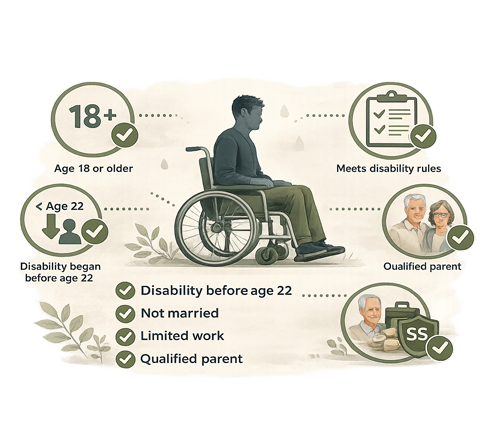
Who May Qualify
In general, an adult child may qualify if:
- They are age 18 or older
- They meet Social Security’s adult disability standard
- Their disability began before age 22
- They are not married, with limited exceptions
- They have not engaged in substantial work after age 22
- A parent is receiving Social Security retirement or disability benefits, or has died after earning enough work credits
The disability may be physical, developmental, intellectual, neurological, or related to serious mental health conditions. What matters is whether it meets Social Security’s adult disability rules.
How DAC Benefits Work
DAC benefits are paid on a parent’s record, not the adult child’s. The monthly amount is based on a percentage of the parent’s benefit.
These benefits can help families whose child was never able to build enough work history for SSDI on their own. In some cases, DAC benefits can reduce or replace SSI, depending on the amount received and the person’s overall financial situation.
Because SSI, DAC, Medicaid, and Medicare can interact in complicated ways, timing matters.

When Families Should Start Thinking About DAC
Families may think about DAC benefits at key transition points:
- Around the child’s 18th birthday
- When a parent files for Social Security retirement or disability
- When a parent receiving benefits dies
These changes can affect whether the adult child may qualify for DAC, SSI, or both. They can also affect health coverage and monthly benefit amounts.
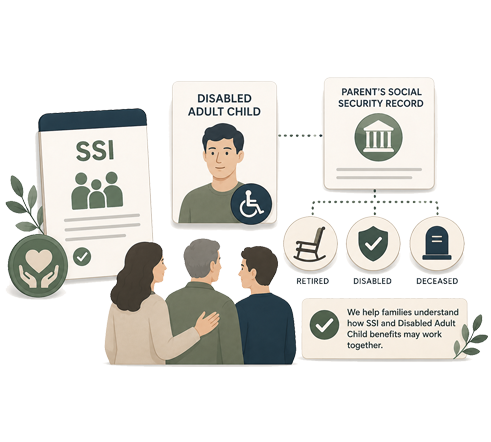
What We Look At in a DAC Case
When a family contacts us about DAC benefits, we usually look at five main questions:
- Did the disability begin before age 22?
- Did the child work after age 22?
- Is the adult child disabled under Social Security’s adult rules now?
- Is a parent receiving benefits, or did a parent who worked enough pass away?
- How would DAC affect SSI, Medicaid, or future Medicare eligibility?
We review medical, school, and other records to help answer these questions and map out the best next step.
How Spector & Lenz Helps
In DAC cases, we help families understand a complicated set of rules in plain language. We gather and organize records, assess the disability timeline, evaluate benefit options, and help decide whether to pursue DAC, SSI, or both.
If a claim is denied, we also help with appeals and hearings. Our goal is to help families build a more stable financial foundation for the adult child’s future.
When to Reach Out
You may want to talk with us if your child with a disability is approaching age 18, an adult child with a long-standing disability cannot maintain steady work, a parent is applying for retirement or disability benefits, a parent has died, and you are unsure what benefits may now be available, or your adult child already receives SSI, and you want to know whether DAC benefits make sense.
A conversation can help you understand what may be available and what steps come next.
Disclaimer
This page provides general information about Disabled Adult Child benefits in Social Security disability law. It does not provide legal or financial advice. Contacting us through this site does not create an attorney-client relationship. We represent you only after we agree to take your case and you sign our retainer agreement and any required government forms. We cannot promise specific results, and we only pursue applications and appeals when we believe there is legal merit to do so.