
What Is a Continuing Disability Review?
A Continuing Disability Review is Social Security’s check to see whether you still meet the disability rules.
These reviews are routine and required by law. The key questions are:
- Has your medical condition improved?
- If so, has it improved enough for you to return to regular work?
If your limitations are still serious and your records support that, many people keep their benefits after a review.
How Often Reviews Happen
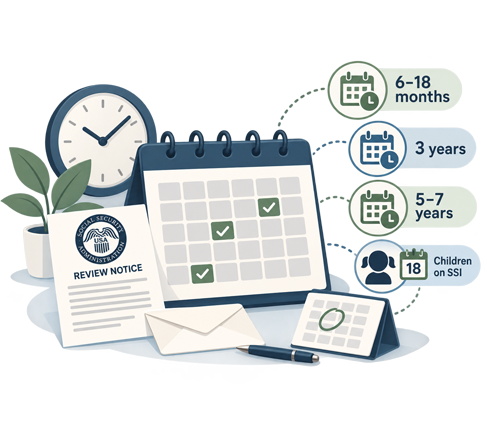
Social Security sets review timing based on how likely the agency thinks it is that your condition will improve. For example:
- Improvement expected: Review about 6–18 months after approval
- Improvement possible: Review about every 3 years
- Improvement not expected: Review about every 5–7 years
Children on SSI also have periodic reviews and a special review around age 18.
You will receive a letter when a review starts explaining what to fill out and where to send it.
The Main CDR Forms
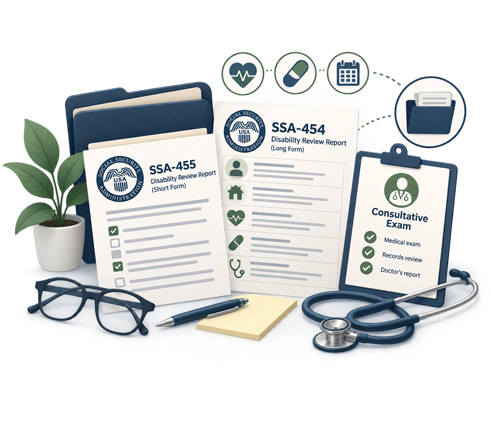
Most people see one of two forms:
- Short form (SSA‑455): A brief update about your health, treatment, and work
- Long form (SSA‑454): A detailed report about your conditions, daily activities, and doctors
Sometimes Social Security also sends you to a consultative exam with one of its doctors.
What Social Security Looks At
During a CDR, Social Security reviews:
- Recent medical records
- Your answers about symptoms, daily life, and any work
- Reports from any exam it arranges
For adults, the focus is whether you can now do substantial work on a regular basis. Benefits are supposed to continue unless there is evidence of meaningful medical improvement tied to your ability to work.

How To Handle a CDR Letter
If you get a CDR notice:
- Do not ignore it—deadlines matter
- See whether you received any forms to fill out
- Gather updated doctor and clinic information
- Answer honestly and specifically about good days and bad days
- Keep copies of everything you send
If you are unsure how to handle this process, talking with a lawyer first can help.
How Spector & Lenz Helps
We can:
- Explain what the review letter means
- Help you complete CDR forms in a way that matches your medical records
- Make sure important providers are listed and records are requested
- Advise you about limited work and how it may affect your review
- Appeal if Social Security decides your disability has “ended” and benefits should stop
Our goal is to make the process easier and safeguard the benefits you worked hard to obtain.
If Social Security Says Benefits Will Stop
If you receive a notice saying your disability has ended:
- You can appeal, but deadlines are short
- In many cases, you may ask for benefits to continue while you appeal
- You can submit updated medical evidence and statements about why your condition still limits you
Contact a lawyer as soon as you receive this kind of notice so you understand your options.
When to Reach Out
You may want to talk with us if you received a CDR packet and feel overwhelmed, your condition has not improved—or has worsened, you tried some work and worry how it will be viewed, or you received a notice that Social Security plans to stop your benefits.
You do not have to face a Continuing Disability Review alone.
Disclaimer
This page provides general information about Continuing Disability Reviews for Social Security disability benefits. It does not provide legal advice. Contacting us through this site does not create an attorney‑client relationship. We represent you only after we agree to take your case and you sign our retainer agreement and any required government forms. We cannot promise specific results, and we only move forward with appeals when we believe there is legal merit for more review.